The volcano that warmed the world
What happened beneath the South Pacific on January 15, 2022, and how a single underwater eruption disrupted the atmosphere across the planet.
A massive explosion at the Hunga Tonga–Hunga Haʻapai volcanic arc sent shockwaves racing across continents and injected unprecedented amounts of water vapour into the stratosphere. Scientists later traced a measurable rise in global temperature to this single event, an eruption powerful enough to reshape the sky itself.
How the eruption unfolded
A sequence of fast-building events: pressure surges, violent steam flashes, and the collapse of the volcanic structure, unfolded within minutes, intensifying the eruption into one of the most powerful atmospheric disturbances ever recorded.
Below is a simplified step-by-step reconstruction of how the eruption progressed, based on satellite imagery, pressure sensors, and ocean-surface observations.
What followed was a rapid escalation – pressure spikes, explosive steam flashes as magma hit seawater, and structural collapse within the volcano. Together, these forces amplified the eruption into a planet-shaking event.
Satellite view of the eruption
A geostationary satellite captured the eruption in real time, revealing the shockwave, plume expansion, and atmospheric ripples as they spread across the South Pacific within minutes.
The volcano’s summit was just ~150 m below sea level
Most volcano summits rise hundreds to thousands of meters above sea level. Hunga Tonga’s unusually shallow summit allowed seawater to interact directly with erupting magma, supercharging the explosion.
Water vapour from the eruption reached the mesosphere
Major eruptions typically inject material only into the stratosphere (10–50 km). This eruption sent moisture above 50 km, an extremely rare event showing how powerful the vertical blast was.
~10% more water vapour entered the stratosphere
The stratosphere normally contains very little water vapour. A sudden 10% increase from one eruption temporarily altered Earth’s radiative balance and atmospheric chemistry.
Estimated +0.035°C global temperature rise
That number seems small, but for a single eruption it’s measurable globally, and unusual, since major volcanic events typically cool the planet instead of warming it.
Rise in monthly global temperature
Monthly global temperature anomalies before and after the Hunga Tonga eruption. The solid line shows observed temperatures; the dashed line shows the long-term baseline used by climate scientists.
What was so different about Hunga Tonga?
Unlike typical volcanic eruptions that cool the planet, Hunga Tonga blasted an unprecedented amount of water vapour straight into the stratosphere, enough to temporarily alter Earth’s radiative balance. This wasn’t just an eruption; it was a climate-altering event outside the patterns scientists normally expect from volcanoes.

Understanding the scale
The eruption injected an extraordinary amount of water vapour into the atmosphere. Here’s how the total volume compares to a standard Olympic-sized swimming pool.
Steam released
146,000,000,000 L
Estimated total water vapour injected into the stratosphere by the January 15 eruption.
One Olympic swimming pool
2,500,000 L
Standard volume used for comparing large-scale water measurements.
That means the eruption released the equivalent of 58 Olympic pools of water vapour, shooting higher into the atmosphere than any eruption ever recorded.
Was Hunga Tonga the biggest?
A look at how the 2022 eruption compares to some of the most powerful volcanic and explosive events in recorded history, measured in megatons of TNT.
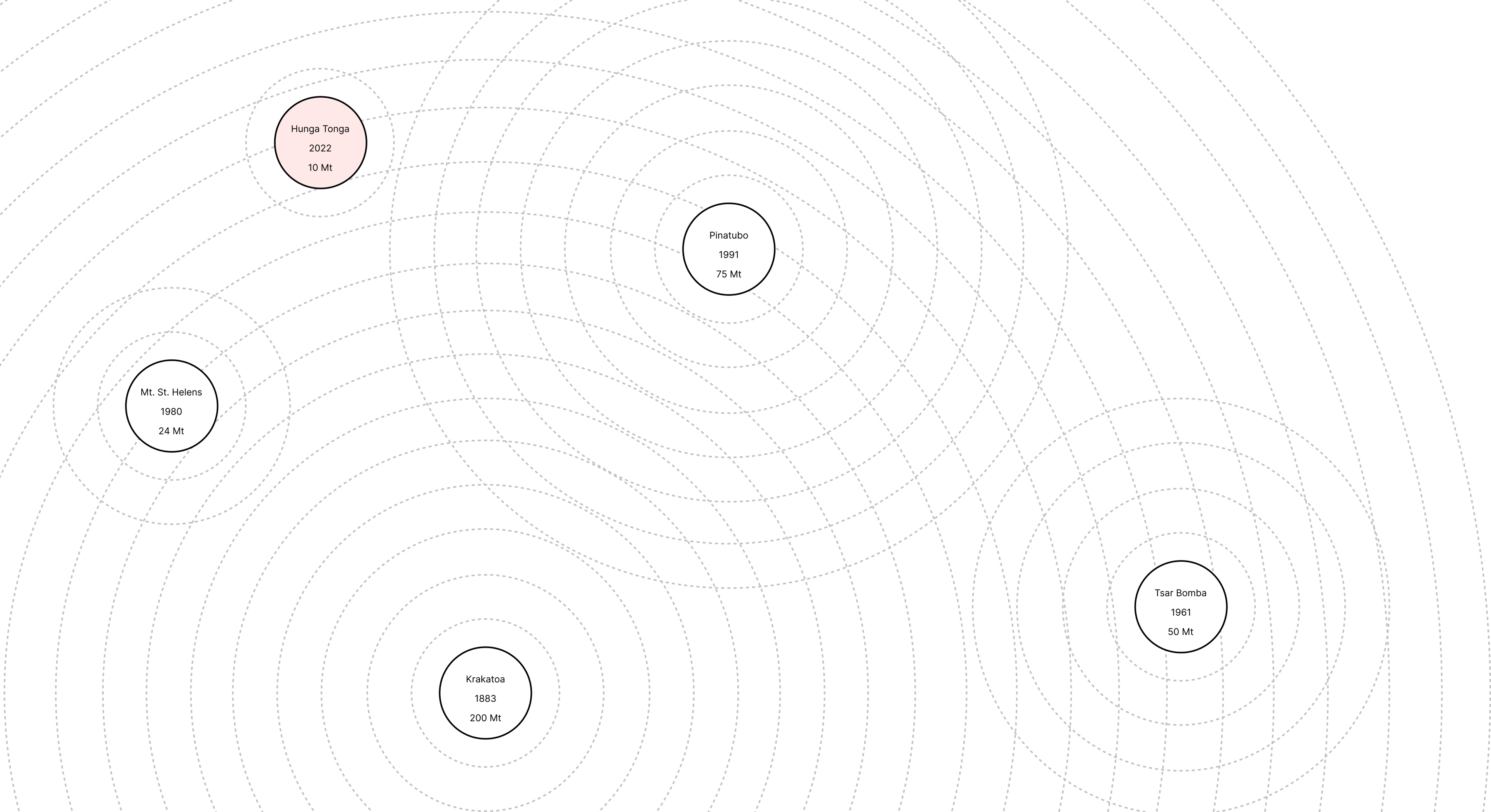
Each ring represents 10 TNT (a high explosive formed from toluene by substitution of three hydrogen atoms with nitro groups).
A violent eruption, a planet-scale disturbance
The Hunga Tonga eruption wasn’t just another volcanic event. It rewrote the rules of how a single explosion can influence the atmosphere. By blasting an extraordinary amount of water vapour into the stratosphere and beyond, the volcano created effects normally seen only in climate-changing geological events.
The shockwaves circled the planet. Satellites recorded atmospheric ripples stretching across oceans. And the excess moisture trapped enough heat to register a measurable rise in global temperature, a rare outcome, since major eruptions usually cool the planet instead.
What unfolded in January 2022 is now regarded as one of the strongest natural atmospheric disturbances in modern history. It was brief, but it left fingerprints across the atmosphere, the climate system, and global scientific records.
Hunga Tonga didn’t just erupt.
It reset what we thought a volcano could do.